Reading a simulation result
KPIs, monthly energy, solver metrics, and the result layout.
Reviewed
What this is for
One pairing, read in full. The matrix cell holds three numbers so you can compare. This page is why they came out that way, and what to change. The printable sheet is a different route; this one is for deciding.
Until the design has modules and the condition set has weather, the matrix cell reads Not ready. Draw a field segment and fetch a year first. The rest of this article is the page a completed run draws.
Steps
- Open Results. A finished cell opens this page.
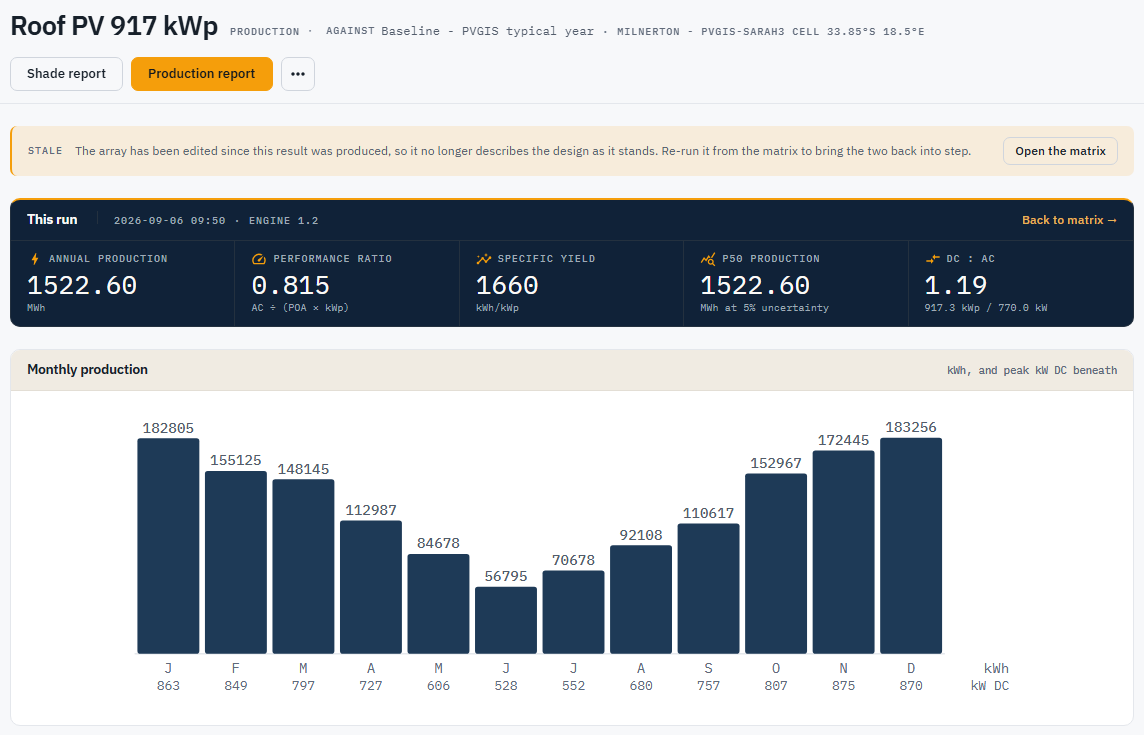
- The strip is This run: when it finished, which engine produced it, and five figures. Annual production is the year. Performance ratio is AC over in-plane irradiance times nameplate (
AC ÷ (POA × kWp)). Dividing by a later step would make a dirtier array look better. Specific yield compares arrays of different sizes. The probability tile is the modelled P50 (or whichever exceedance the run used) at the combined uncertainty. DC : AC is a dash until both nameplates exist. - Monthly production is kilowatt-hours with peak kilowatts DC beneath. The DC peak, never the grid-side AC: the AC figure is capped by the inverter and prints the same ceiling every sunny month.
- Below that: the loss waterfall and the donut (same numbers, two cuts), constrained DC output by cause, Simulation and temperature metrics (operating, solved and clipped hours, the two operating temperatures, annual shading and mismatch loss, run time), production probability, and a per-module solar-access map if the run wrote one. Shade report and Production report are the two buttons in the head.
- Stale names what moved after this number was made: the array, its wiring (an inverter, its count or the stringing), the condition set, or the engine itself. The number is still the one that may have gone to a client. Re-run from the matrix. Hours whose maximum-power search satisfied neither exit test are flagged and still in the totals - that is not a zero-production hour.
Solved hours count every hour with light on the array; operating hours count those that produced. A large gap points at the solver rather than at the weather.
Tips and common mistakes
- Do not treat the matrix cell as the report. The cell is the comparison; this page is the argument.
- A dash on DC : AC is an unstated nameplate, not a ratio of zero.
- Export 8760 CSV from the overflow if you need the hours. Do not re-type monthly totals into a spreadsheet and call it the year.