Layout and hand edits
Auto layout, the usable plan, and edits that survive a re-lay.
Reviewed
What this is for
Filling the outline, then keeping the exceptions. The engine tiles frames into the usable plan. Adding, removing, moving and turning a module are stored against that module's place in the grid, so changing a tilt or a setback later does not throw them away.
Steps
- Draw or open a field segment, pick a module, Update field segment. The array fills.
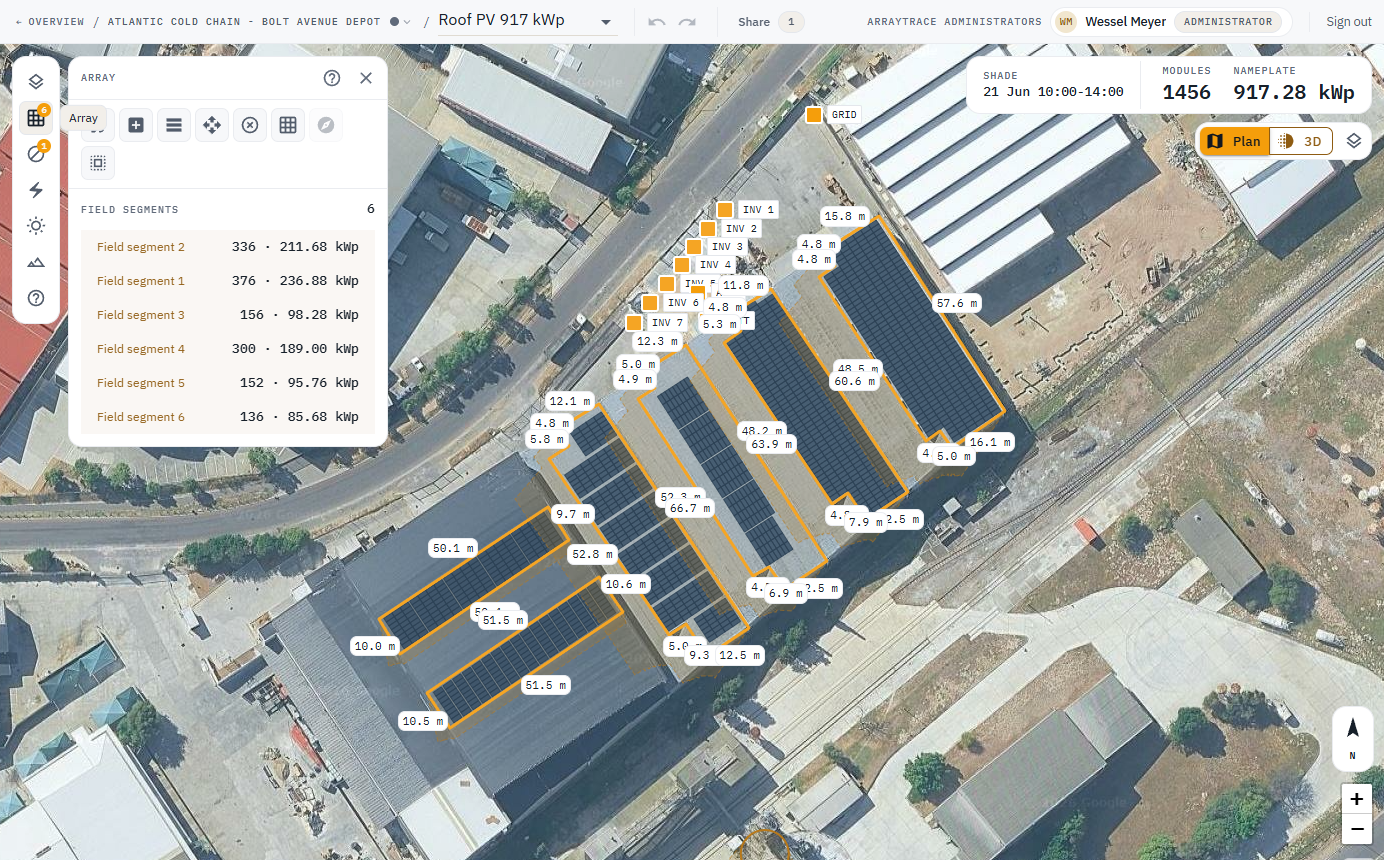
- Once a segment is selected: Add modules, Fill a row, Move modules, Remove modules. Align the module grid pins where the tiling starts, and is then obeyed literally - which is how two segments either side of a walkway are lined up. Without a pinned origin, Align across rows and Align along rows decide where the slack goes: Centred aims at the middle of the room and goes there, so it may cost a module; Near edge and Far edge never do. A pinned origin overrides both until Clear the explicit origin.
- The dashed outline is the usable plan: setback, obstruction setbacks, shade removals. Modules stop inside it. It is drawn for the selected segment only.
- R rotates modules portrait / landscape. Hand edits are keyed on a grid address. Shade removal uses the same addresses and stores nothing about what asked for it, which is why Restore all on the Shading rail puts back both the cutoff and what you took out by hand.
- A frame is placed only when the whole of it is covered, so one module in shade drops all of it. Fill partial frames, shown once a frame is more than one module, places the modules that fit instead. Dropping the frame to 1-up 1-wide does the same by making every module its own frame.
A locked design refuses these writes. Duplicate first if you still need to edit.
Tips and common mistakes
- Where the grid starts decides how much roof gets used. The engine tries the phases the outline's own corners offer unless you pin it.
- Module spacing is a gap on all four sides, not a sum with row spacing. Row spacing is the pitch from one row to the next; Column spacing is the gap across the row between one frame and the next.
- A very large design is slower to pan because every module is drawn. Split a huge site across several designs if the drawing dies.