Voltage drop and electrical issues
How drop is calculated, and why issues do not block generation.
Reviewed
What this is for
Whether the copper you chose will carry the current, and whether the volts that arrive are still inside the window. DC and AC budgets are separate, with separate settings and issue kinds: Max voltage drop and Max AC voltage drop on the project's profile under Design defaults. A design spending three percent on a long run and half a percent on short strings can meet a combined target and fail the rule an inspector works to.
Voltage drop is current times resistivity times conductor length. The factor of two lives in that length (out and back) and is applied exactly once.
Steps
- Choose the copper on each zone card under Conductors (String and Home run), and under AC side if the zone models its AC run. After Generate wiring, issues sit under the summary on the designer's Electrical rail. They do not stop the layout. The outputs page lists no issues; it carries the evidence per run. Over-ampacity is marked over on the schedule's current column. Drop is a percentage on the same row, or a dash when no size was chosen.
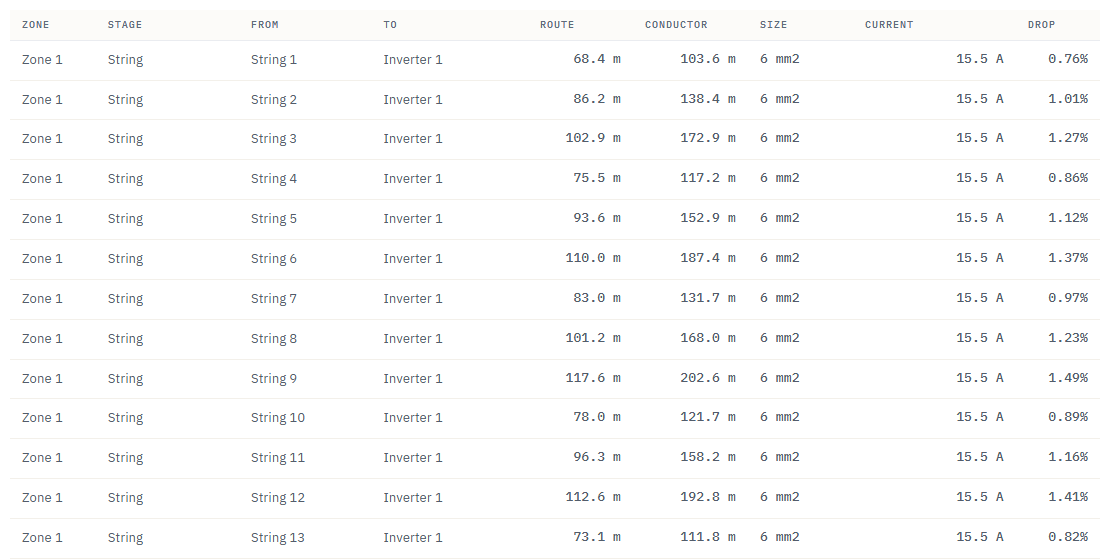
- Typical named issues, each with its figures: no conductor selected (runs carry a length but no size or drop); hardware not placed (lengths estimated from the centre of the array); a run past the drop limit, or a conductor past its rating; a tracker past its current or balance limit; an inverter loaded past its DC maximum, or one that states no maximum so nothing checked it; optimizer required (wires anyway, cannot lock); strings running too close to the inverter's tracking floor; the grid connection, an AC panel or the storage bank not placed; a transformer implied by two stated voltages. A run past its drop limit names which budget it broke, DC or AC: AC runs are held to the AC budget, not the DC one.
- An unplaced inverter estimates from the centre of its array. Falling back to the connection point for an inverter would report zero metres, which is a claim that no cable is needed. Place the hardware on the zone's Placement row to replace the estimate.
- An inverter family that requires optimizers blocks locking, not generation. You can see the schedule; you cannot make the design a deliverable until the family has what it needs.
Until a segment is in a zone with an inverter, Generate stays disabled and there is no drop column to read.
Tips and common mistakes
- Do not add DC drop to AC drop and compare the sum to one budget. Each budget is its own rule.
- A dash on drop is "no size chosen", not "no drop". The friendlier wrong answer is the more dangerous one.
- Sizing strings at the inverter's tracking floor leaves no headroom for a hot afternoon. Vmp falls as the array heats.