Electrical outputs
Wire schedule, bill of materials, strings, single-line and DXF.
Reviewed
What this is for
Three views of one generated layout: the wire schedule, the bill of materials and the single-line diagram. They are a projection, never three counts of the same thing. Their own page, because they are read rather than edited and a schedule needs the width.
The figures below are as wired, not as drawn on the canvas.
Steps
- Open Electrical on the project strip, or Wire schedule, bill of materials and diagram at the top of the designer's Electrical rail once wiring exists. From the designer the page opens on the design you were wiring; on a project with more than one design, the picker under the section strip says which one you are reading. With nothing generated the page says This design has no wire schedule - not "has not been wired", because changing a zone parameter drops the stored schedule and the page cannot tell a design nobody has wired from one whose schedule was just dropped. The diagram pane says Nothing to draw yet until a zone has an inverter and modules in it.
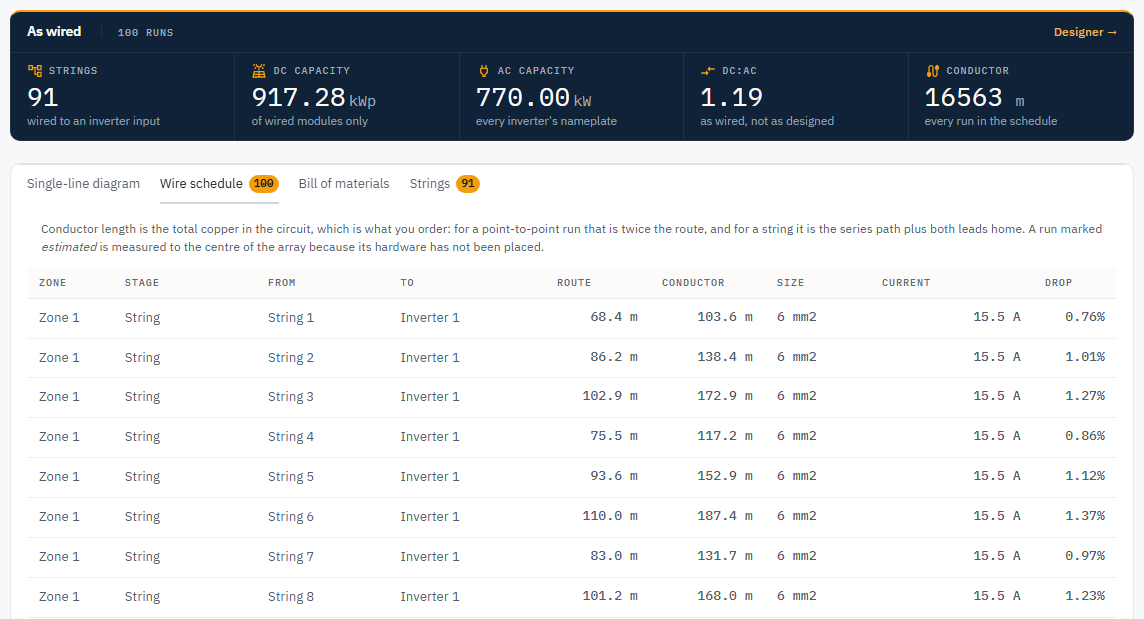
- As wired: strings wired to an inverter input, DC capacity of wired modules only, every inverter's nameplate, DC:AC as wired, conductor metres of every run. Captions matter when orphans exist: unwired modules would otherwise make the headline look like the canvas.
- Four tabs:
- Single-line diagram. Identical circuits are drawn once and counted. Surge arresters, earthing and the load split are not modelled, so none of them are drawn. What the drawing does claim is listed above it and printed on the file.
- Wire schedule. Route length vs conductor length (the copper you order: twice the route on a point-to-point run). est means hardware has not been placed, so the length is to the centre of the array. A run with no size chosen dashes the drop -
0.00%would read as lossless cable nobody picked. - Bill of materials. Derived from the generated wiring, never counted separately. An unpriced line is a dash, never free. Conductor quantity is metres. Price from says whether each line came from your own price book or the region pack's indicative figures, which are not a basis for a quote.
- Strings. Each string's length, the inverter and tracker it lands on, its combiner, and its voltages and current.
- Single-line PDF is the primary export. Layout DXF and Scene for PVsyst sit in the overflow. Regenerating belongs here as well as on the rail: this is the page you are on when the schedule describes an array that has since moved.
Tips and common mistakes
- Do not add the canvas module count to the wired DC capacity and call it a check. Wired is the system; the rest is still on the roof and produces nothing.
- A stale layout is rebuilt on the way in when you could have pressed the button yourself. Reaching a Stale banner means no edit rights, a locked design, or segments that are no longer in any zone.
- Exporting a report must not rewrite the design. The builder reads the stored layout and never generates one.